Separation Anxiety in Dogs: Signs, Causes and How to Help
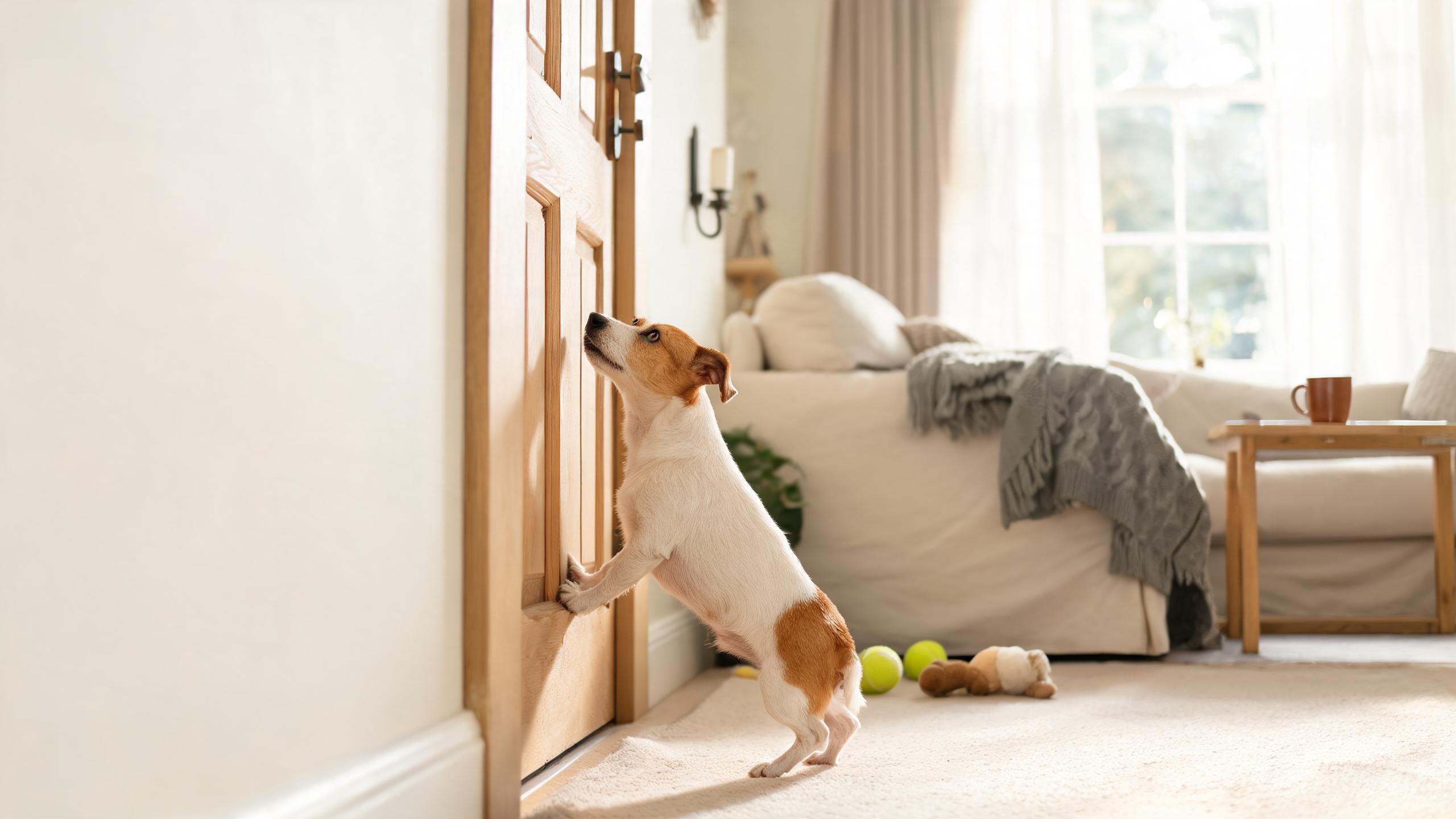
Does your dog panic when you leave? Learn to recognise separation anxiety, understand why it happens, and follow a calm, practical plan to help your dog feel safe alone.
For some dogs, the click of the front door closing is the start of genuine distress. Separation anxiety is one of the most common — and most misunderstood — behaviour problems in dogs, and it became far more visible as households that adopted during lockdown returned to the office. The reassuring news is that, with patience and the right approach, most dogs can learn to cope with being alone.
What separation anxiety actually looks like
Separation anxiety is more than a dog who would rather you stayed. It is real panic at being left, and it shows up in fairly consistent ways:
- Vocalising — barking, howling or whining that starts soon after you leave.
- Destructive behaviour, often focused on doors, windows or your belongings.
- Toileting indoors in a dog who is otherwise house-trained.
- Pacing, drooling or trembling.
- Frantic greetings and shadowing you around the house when you are home.
A telltale sign is timing: the distress kicks off within the first 15 to 30 minutes of you leaving. A camera or phone left recording is one of the most useful tools for working out what is really going on.
Why it happens
There is rarely a single cause. Triggers include a major change in routine (a return to work, a house move, a new baby), the loss of a person or another pet, a lack of early experience being alone, or a naturally sensitive temperament. Importantly, it is not your dog being "naughty" or "spiteful" — it is fear, and punishing it makes it worse.
A calm, practical plan
The goal is to teach your dog that being alone is safe and unremarkable. This takes weeks, not days, and consistency matters more than intensity:
- Build up alone-time gradually. Start with seconds, not hours. Step out, return before your dog panics, and slowly extend the time.
- Make departures and arrivals boring. No emotional goodbyes or over-the-top hellos. You want "leaving" to feel like nothing.
- Create a positive association. A special long-lasting chew or a stuffed toy that only appears when you leave can change how your dog feels about your departure.
- Meet their needs first. A dog who has had a good walk and some mental stimulation settles far more easily than one bursting with energy.
- Keep a predictable routine. Anxious dogs find security in knowing what happens next.
For moderate to severe cases, do not go it alone. A qualified, reward-based behaviourist can build a tailored desensitisation plan, and your vet can rule out medical causes and advise whether additional support is appropriate.
The wellbeing foundation
Behaviour does not sit in isolation from general health. A dog who is well exercised, mentally stimulated, on a settled routine and well nourished simply copes better. Omega-3 fatty acids, and DHA in particular, support brain health as part of a balanced diet — one reason a good omega-3 is a sensible part of an anxious dog's overall wellbeing routine, alongside the training that does the heavy lifting.
What not to do
Do not punish the symptoms — the mess, the noise, the chewing are products of panic, and telling off an already frightened dog deepens the fear. Do not flood your dog by leaving them for long, distressing stretches "to get used to it." And do not expect overnight change; the dogs who recover are the ones whose owners stay patient and consistent.
The hopeful bit
Separation anxiety is treatable. With gradual training, a few smart routines and professional help where needed, the vast majority of dogs learn that alone time is safe — and you get to leave the house without a knot in your stomach.
As part of supporting your dog's overall wellbeing, PetJesty's Vegan Omega 3, 6 and 9 Algae Oil provides DHA that supports brain health from a clean, plant-based source — a small daily foundation while the training does its work. For anything beyond mild anxiety, please loop in your vet or a qualified behaviourist; they can make a real difference.